

Engine Swap Adventures – Finding the Perfect Match for Your S2000
Why Swap Your S2000's Heart: The Engine Swap Revolution
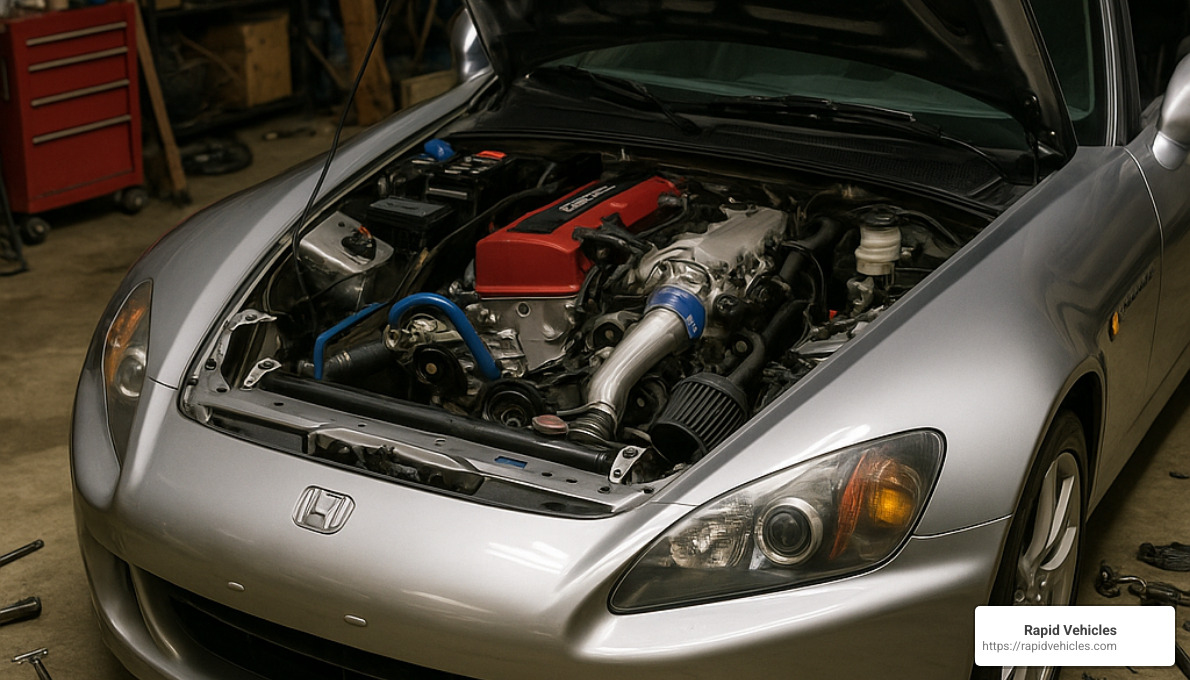
The world of honda s2000 engine swap options has exploded in recent years, creating a genuine revolution among enthusiasts. As these beloved roadsters age, many owners find themselves at a crossroads when that legendary F-series engine starts showing its age.
"I've owned my S2000 for 10 years now, and it's gone through more phases than I think any S2000 ever has." - Zack Leitzke, S2000 owner
Let's be honest – there's something magical about that high-revving F20C screaming to 9,000 RPM, but there are compelling reasons to consider a swap. For starters, those original engines aren't getting any cheaper. A used F20C or F22C can set you back $4,000-$6,000, while a new short block might drain your wallet to the tune of $17,000. Ouch!
Meanwhile, that K24 engine from a 2006-2008 donor car? You might score one for as little as $500 from a junkyard. That's not just easier on your bank account – it also delivers more usable torque in the mid-range where most of us actually drive.
Beyond the financial math, many owners crave more power, more torque, or simply something different after years with the same setup. The S2000 platform has proven remarkably adaptable, welcoming everything from modest power bumps to complete personality changes.
K20/K24 swaps have become the community favorite, offering improved torque while maintaining that Honda DNA. They typically deliver 210-215 whp on pump gas and cost between $5,850-$14,850 depending on your approach.
For those with bigger dreams (and engine bays), the LS V8 swap delivers massive power while cleverly maintaining the S2000's perfect 50/50 weight distribution. Yes, you'll need a T56 transmission, but the results are worth it.
Not to be overlooked, the J-Series V6 offers a strong torque curve that transforms the driving experience, though you'll need custom mounts and wiring to make it happen.
For the boost-hungry crowd, the K20C1 from the Civic Type R produces 300+ hp with its factory turbo, though it's worth noting these setups are typically recommended for race use only.
And then there are the true power junkies. The 2JZ-GTE swap paves the way for 1,000+ hp builds, provided you're ready for significant fabrication work and possibly a reinforced chassis.
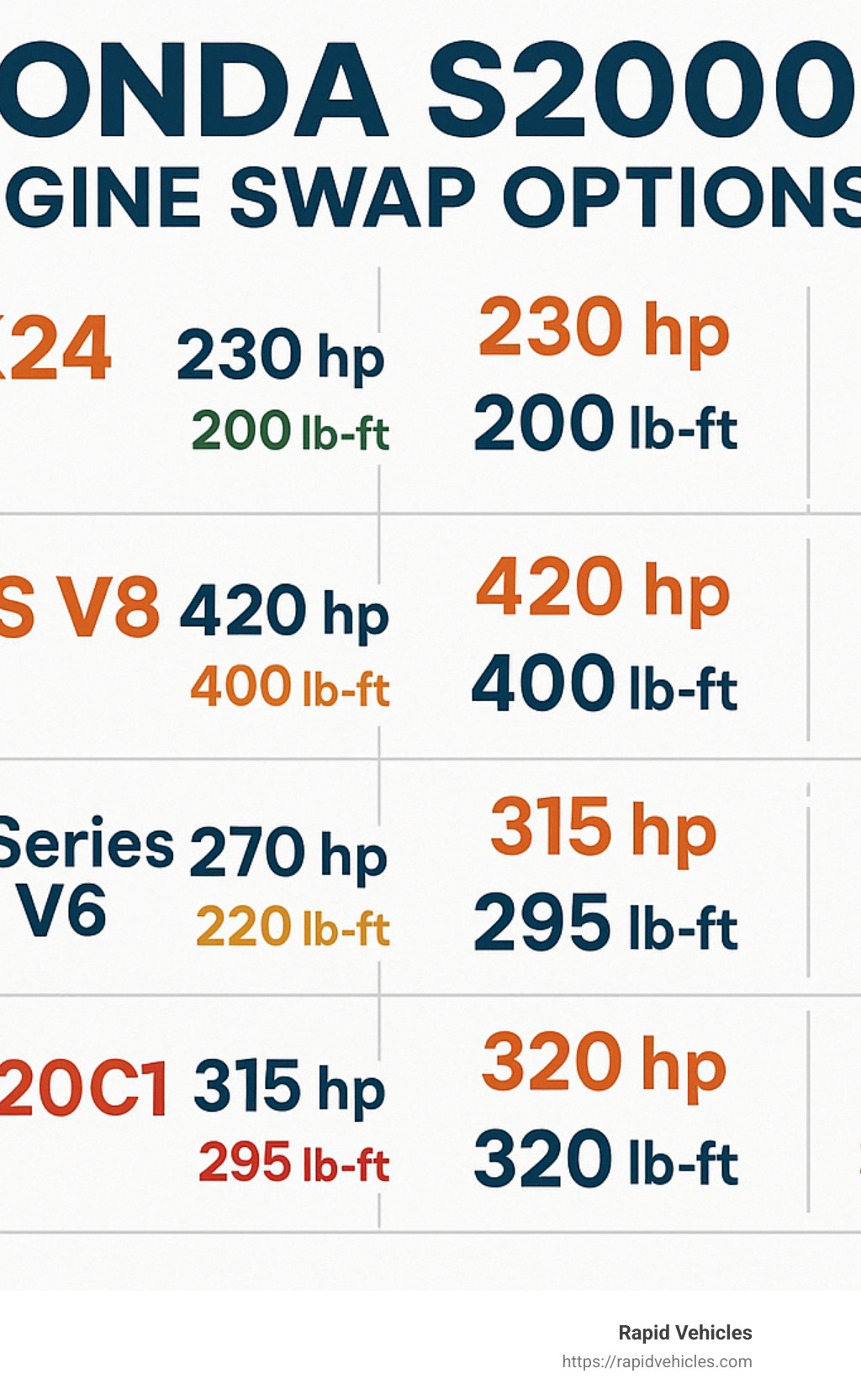
The stock S2000 came with either an F20C (2000-2003 AP1) or F22C (2004-2009 AP2) engine. While these high-revving gems are engineering masterpieces, they're becoming increasingly rare. When faced with a blown engine, many owners find themselves weighing the costs of rebuilding against the benefits of upgrading.
According to scientific research on engine longevity, modern swap candidates often offer improved reliability alongside their performance benefits. Plus, with emissions regulations tightening in many areas, newer engines sometimes provide an easier path to compliance.
Whether you're looking to breathe new life into a tired S2000, chase more power, or simply try something different, engine swaps offer a path to reinvent your roadster while potentially saving money compared to rebuilding the original engine. It's no wonder the honda s2000 engine swap trend continues to gain momentum among enthusiasts who refuse to let these special cars fade away.
Why Consider an Engine Swap?
The high-revving F-series heart of the Honda S2000 is a mechanical masterpiece, but there comes a time when many owners find themselves contemplating a honda s2000 engine swap. Whether it's due to a blown engine, hunger for more power, or simply wanting something different, the reasons are as varied as the S2000 community itself.
Cost Considerations
Let's face it—when your S2000's engine gives up the ghost, the financial reality can be sobering. One owner shared his experience: "I recently bought and promptly after a month blew up my 02 s2000 engine." Talk about a rough introduction to S2000 ownership!
The numbers tell a painful story for those seeking factory replacements. Used F20C/F22C engines typically command $4,000-$6,000 if you're lucky. Need a new short block? Prepare to shell out up to $17,000. A complete professional rebuild? That'll set you back $8,000-$12,000.
Meanwhile, a K24 from a donor Accord or TSX might cost just $500 from a junkyard. Suddenly, that engine swap starts looking like a smart financial move rather than just a performance upgrade.
Performance Improvements
While the S2000's factory engine delivers an impressive 240 hp in the F20C, its 153 lb-ft of torque leaves many owners wanting more. As one forum member aptly put it: "The power band is so tiny and all at the top end."
Most popular swap candidates deliver that missing torque in spades. The K24 offers better mid-range grunt while maintaining similar peak power. Step up to a J-Series V6 and you'll enjoy substantially more twist throughout the rev range. Go all-in with an LS V8 swap and you're looking at 400+ lb-ft of tire-shredding torque. For the boost-happy crowd, a K20C1 Type R engine brings 300+ hp and 300+ lb-ft thanks to its turbocharger.
Engine Availability
Honda stopped making new F20C/F22C engines years ago, creating a genuine scarcity problem. As the S2000 ages gracefully into modern classic status, finding good replacement engines becomes increasingly challenging.
In contrast, K-series engines are practically everywhere—in junkyards, at importers, and through online marketplaces. This abundance translates to better parts availability and lower costs for both the initial purchase and ongoing maintenance.

Reliability Factors
Some S2000 owners turn to engine swaps after pushing their factory engines beyond their limits. One owner who now runs a 2JZ in his S2000 shared: "After blowing up four F20 blocks, I decided to switch to a 2JZ for reliability and power."
While that's an extreme example, it highlights how different engines have different strengths. The K-series, for instance, has proven remarkably stout even when making 400-500 horsepower with forced induction. This makes it an excellent choice for those seeking a balance of reliability and performance potential.
Recent scientific research on engine longevity suggests that modern engines with proper management systems can deliver surprising durability even when modified—something that wasn't always true with older designs.
Emissions Compliance
The reality of emissions regulations can't be ignored, especially in states with strict testing requirements. Generally speaking, staying within the Honda family (like with K-series swaps) makes emissions compliance more straightforward than cross-brand options.
However, all engine swaps require careful attention to emissions equipment if you want to keep your car street legal in regulated states. This might mean retaining catalytic converters, oxygen sensors, and even the evaporative emissions system depending on your location.
Pros & Cons of Rebuilding vs Swapping
Before diving into a swap, it's worth weighing the rebuild option carefully.
Rebuilding Pros: You'll maintain your S2000's original character and collectibility. There's no fabrication or adaptation required, wiring remains simple, and costs might be lower if engine damage isn't extensive.
Rebuilding Cons: You're still limited in torque improvement potential, F-series parts are expensive and becoming harder to find, and you're essentially back to the same power ceiling as before.
Swapping Pros: Many swaps offer lower costs (especially K-series), improved torque for better drivability, better parts availability, higher power potential, and in some cases, more modern engine technology.
Swapping Cons: You'll need to deal with fabrication and adaptation, more complex wiring, potential weight distribution changes, possible impact on collectibility, and emissions compliance challenges.
As one pragmatic S2000 owner summed it up: "If your F22C is healthy, a K24 swap isn't worth the money. But if your original motor blows, the swap becomes much more attractive financially."
The decision ultimately comes down to your goals, budget, and how you use your S2000. Many owners find that the right engine swap breathes new life into their beloved roadster, changing it into an even more capable and enjoyable machine.
Popular Engine Swap Options for the Honda S2000
When it comes to breathing new life into your S2000, the engine swap community has explored virtually every possibility. Let's explore the most popular options that have proven successful for enthusiasts looking to transform their S2000 experience.
K20/K24 honda s2000 engine swap
The K-series has become the darling of the honda s2000 engine swap world, with the K24A2 from the 2006-2008 Acura TSX leading the charge. There's good reason for this popularity – these engines deliver a perfect balance of performance gains, reliability, and relative simplicity.
That mid-range torque boost makes a world of difference in daily driving. Where the stock F20C feels somewhat anemic below 6000 RPM, a K24 pulls strongly from much lower in the rev range, making the car far more enjoyable on regular roads. Most builders report around 210-215 wheel horsepower on pump gas without breaking a sweat.
"My K24-swapped S2000 completely transformed how I use the car," shares Mike, a long-time S2000 owner. "I used to have to wring the F20C's neck to get anywhere, but now I have usable power everywhere in the rev range."
The aftermarket has responded enthusiastically to this trend, with companies like Hasport and Innovative offering well-engineered mounting solutions. You'll need an adapter plate for the transmission (popular options come from Inline Pro, 2NRS, or Ballade Sports), and there are several approaches to addressing the coolant neck differences.
For wiring, options range from fully custom harnesses to more user-friendly plug-and-play solutions that make installation significantly easier. This accessibility has helped make K-swaps particularly dominant in competitive racing series like Gridlife GLTC, where their combination of power, reliability and weight balance shines.
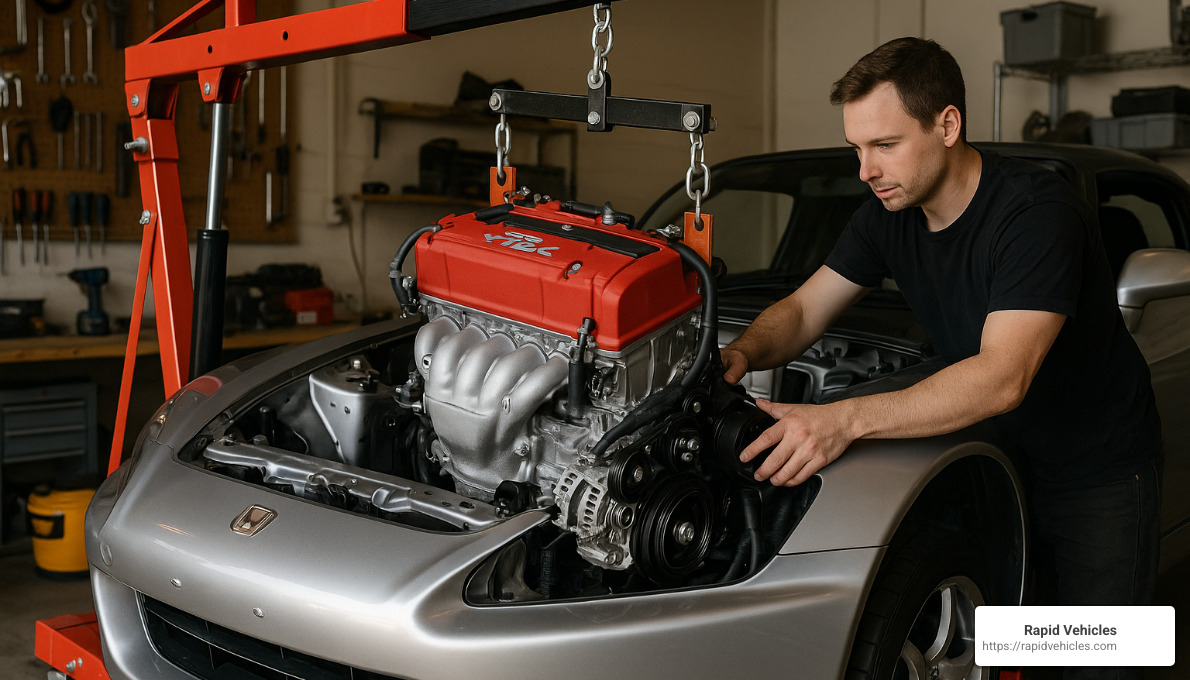
J-Series V6 Swap
For those seeking serious torque while staying in the Honda family, the J-series V6 offers a compelling alternative. These engines, sourced from the Acura TL (J32) or various Honda/Acura models (J35), transform the S2000's character without abandoning its Japanese heritage.
The torque difference is immediately noticeable – up to 280 lb-ft in some configurations, giving the S2000 a muscular punch it never had from the factory. As Tim, a J35-swapped owner puts it with a grin: "The torque curve gonna be JUICY." That's an understatement!
Beyond raw power, the J-series brings a distinctive, throaty exhaust note that turns heads. The V6 configuration also helps maintain a relatively balanced weight distribution, though it does add some pounds compared to the factory four-cylinder.
The installation isn't for the faint of heart, requiring custom motor mounts or a specialized kit, along with more complex wiring adaptations. The engine bay fit is tighter, demanding careful planning and potentially some firewall modifications. Most builders also recommend transmission upgrades to handle the increased torque reliably.
Though less common than K-swaps, the J-series creates a unique S2000 that combines V6 grunt with Japanese engineering precision.
LS V8 honda s2000 engine swap
When maximum power and torque are the goal, many builders turn to GM's legendary LS V8 engines. The aluminum LS1/LS6 5.7L engines are popular choices, though even the "truck" 5.3L iron-block engines have found their way into S2000 engine bays.
The numbers tell the story – 400+ horsepower and 400+ lb-ft of torque are easily achievable with even mild builds. What surprises many is that with proper planning, an LS-swapped S2000 can maintain excellent weight distribution. One owner reported, "Car plus full fuel tank and 70# weight in the rear = 3040 lbs" with a perfect 50/50 balance. That's impressive engineering!
The LS swap does require more significant changes, including a T56 six-speed manual transmission in most cases. Custom motor mounts, oil pan modifications, an upgraded cooling system, and a stronger rear differential (the Ford 8.8-inch is a popular choice) are typical requirements.
The result is a completely transformed S2000 that maintains the handling balance that made the platform famous, but with a dramatic power increase that makes it a force to be reckoned with on both street and track.
2JZ & Other Wild Choices
For those who view "too much power" as a challenge rather than a warning, the Toyota 2JZ-GTE inline-six has become the engine of choice. Known for its virtually indestructible block design, the 2JZ has powered S2000s to truly outrageous power levels.
"After blowing four F20 blocks, I decided to switch to a 2JZ for reliability and power," explains one builder whose S2000 now reliably produces over 1,200 horsepower. The 2JZ's legendary strength and massive aftermarket support make it perfect for those with four-digit power goals.
Even more exotic swaps have emerged from the wilder corners of the community. Some brave souls have somehow managed to stuff Dodge Viper 8.3L V10s (with 506 hp and 542 lb-ft stock) into their S2000s. Others have opted for Dodge Ram SRT-10 V10 engines or even three-rotor Mazda rotary setups.
These extreme builds require extensive custom fabrication, completely custom wiring harnesses, and substantial chassis reinforcement. They're not for beginners or the budget-conscious, but they showcase the incredible potential of the S2000 platform when imagination and engineering skill come together.
The trend analysis is clear – while the K-series remains the most accessible and popular choice, the community continues to push boundaries with increasingly creative and powerful engine combinations. Whether you're seeking modest torque improvements or building a four-figure horsepower monster, there's a honda s2000 engine swap path that aligns with your vision.
The Swap Process: Parts, Fabrication & Wiring
Diving into a honda s2000 engine swap is like starting on a mechanical trip. It's exciting, challenging, and incredibly rewarding when done right. Let me walk you through what's involved when you decide to give your S2000 a heart transplant.
Major Components Checklist
Before you crack open that first socket set, make sure you've got all your ducks in a row. Nothing kills momentum faster than realizing you're missing a critical component halfway through!
Your engine swap shopping list should include the donor engine (obviously!), but don't forget about the supporting cast. You'll need proper engine mounts—Hasport and Innovative make great options for most swaps. Then there's the transmission adapter plate, a suitable flywheel and clutch package that can handle your power goals, and appropriate intake and exhaust manifolds.
I remember talking to Mike at a recent track day about his K24 swap. He laughed and said, "I thought I had everything until I realized my oil pan was hitting the subframe. Two more days and $200 later, I was back on track!"
The electrical side is just as important. You'll need a proper engine wiring harness (or adapter), an ECU solution that works with your setup, and potentially fuel system upgrades if you're adding significant power. Don't skimp on the quality of these components—they're the nervous system of your build.
For your drivetrain, decide whether you're keeping the stock transmission or upgrading. The stock S2000 gearbox is pretty robust, but it has its limits, especially with torquey V8 swaps. Your driveshaft might need modification, and some swaps benefit from differential upgrades too.
As veteran swapper Tony once told me, "Buy the best donor engine you can afford. I learned the hard way that saving $500 on a questionable engine can cost you $3,000 in headaches later."
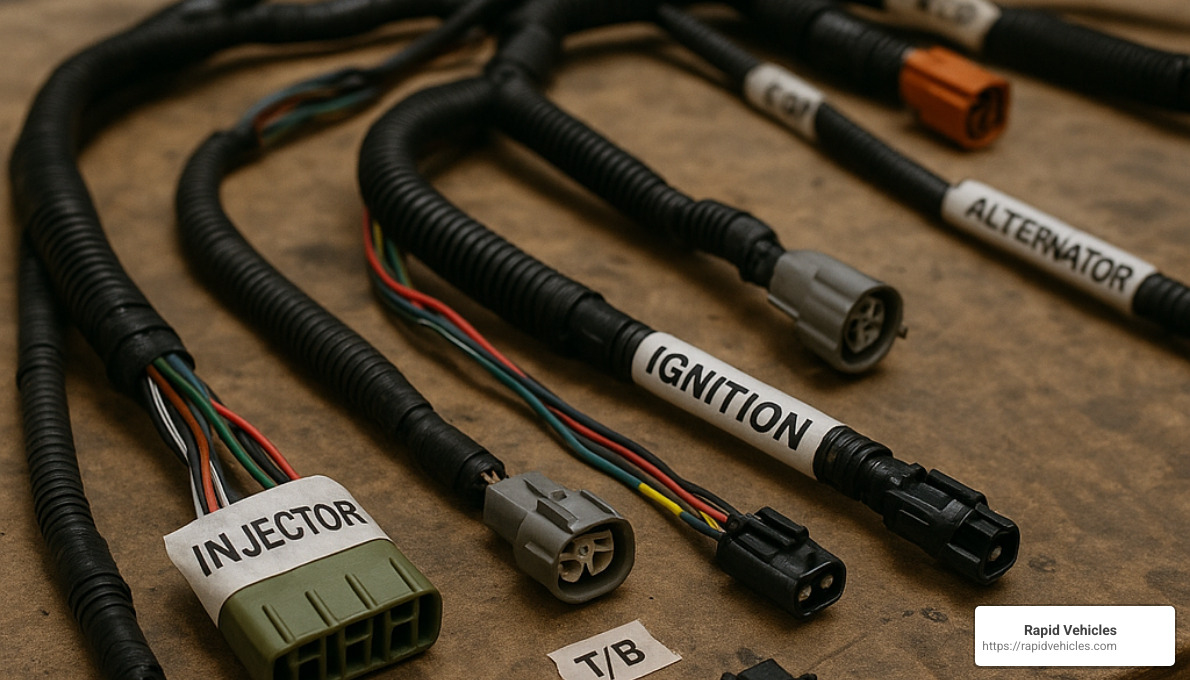
Typical Labor Timeline
If you're tackling a K-series swap, which is relatively straightforward in engine swaps, here's what your calendar might look like:
The preparation phase typically takes 1-2 days. You'll drain all fluids, disconnect the battery and electrical connections, and remove accessories, intake, and exhaust systems. It's tedious but vital groundwork.
Engine removal day is when things get real. You'll disconnect engine mounts, lower the subframe, and extract the engine and transmission as a unit. With good preparation, this can be done in a day.
Next comes donor engine prep, which usually takes 1-2 days. This is where you install the flywheel and clutch, adapt or modify the oil pan to fit the S2000 chassis, install engine mounts, and prepare your wiring harness. A little extra attention here saves massive headaches later.
The installation phase spans about 2-3 days. You'll lower the subframe, position the engine and transmission, connect mounts and drivetrain components, and install the cooling system. Take your time here—proper alignment prevents premature wear and vibration issues.
Wiring and systems integration might be the most tedious part, taking 2-3 days. You'll connect the engine harness, adapt the vehicle harness, install any fuel system upgrades, and connect the cooling system. As Sarah from the S2Ki forum wisely suggests, "Leave your wiring harness unwrapped until you've confirmed all connections. Trust me on this one."
Finally, startup and tuning takes 1-3 days. This includes initial startup and systems check, basic tuning, test drives with adjustments, and final tuning. The first moment when your swapped engine fires up is pure magic—savor it!
For more ambitious swaps like dropping in an LS V8 or 2JZ, add about 30-50% more time. The extra fabrication, custom parts fitting, and more extensive wiring integration all demand patience.
Remember what Jake, who completed a K20 swap last summer, told me: "It's not a race. The extra day I spent triple-checking my cooling system saved me from cooking a brand new engine." Wise words for any swapper to live by!
Costs, Legality & Insurance
Let's talk money, rules, and paperwork – the less exciting but absolutely essential parts of your honda s2000 engine swap journey. Before you start ordering parts, it's smart to understand what you're getting into financially and legally.
Budget Breakdown Scenarios
The financial reality of engine swaps varies widely depending on your approach and goals. Let me walk you through what real S2000 owners typically spend:
For the budget-conscious DIYer tackling a K-series swap, you're looking at about $5,000-$6,000 all-in. This assumes you're doing all the labor yourself (saving thousands) and hunting for deals like a $500-$1,000 junkyard K24A2. You'll still need quality essentials like a $500-$700 mount kit, $400-$600 adapter plate, and about $1,000-$1,500 for wiring and ECU solutions. Don't forget the cooling components and miscellaneous hardware that always add up to more than you expect!
"I managed to complete my K24 swap for just under $6,000 by doing everything myself and sourcing a clean engine from a salvage yard," shared one S2000 owner on the forums. "But I also had most of the tools already and a friend who'd done one before."
Stepping up to a mid-range professional K-series swap pushes the budget to $8,000-$10,000. Here you're paying for peace of mind with a quality tested engine ($1,500-$2,500), premium components throughout, and most importantly, professional labor ($3,000-$4,000). The results tend to be cleaner, more reliable, and finished much faster than most DIY projects.
For those seeking serious power, a premium turbo K-series build starts around $12,000 and easily climbs past $15,000. The built engine alone runs $3,000-$4,000, with a quality turbo kit adding another $3,000-$5,000. Add in the professional labor, tuning, and upgraded fuel system, and you've got a serious investment – but also serious performance.
LS V8 swaps generally start at the $12,000 mark and can quickly reach $20,000+ for professional builds with premium components. The power-per-dollar ratio is excellent, but the initial investment is substantial.
Street vs Track Compliance
Here's where things get tricky for many enthusiasts. That amazing engine swap you're dreaming about might not be street legal, depending on where you live and what engine you choose.
For street-legal swaps, you'll need to maintain or upgrade all emissions equipment, including catalytic converters. California residents (and those in states following CARB rules) face the strictest requirements – your swap needs to meet CARB compliance standards, which is challenging but not impossible with proper planning. Your OBD-II system needs to function with all readiness monitors working, and you'll need to stay within noise regulations too.
One clever S2000 owner in California shared: "I kept all the emissions equipment from the donor K24 and transferred it to my swap. It passed smog without issues because I used a newer, cleaner engine than the original F20C."
For track-only builds, you have much more freedom. Race-only engine packages like the K20C1 Type R conversion don't need to meet street emissions standards. As clearly stated in product documentation: "EPA regulates racing-only engine products under the Clean Air Act; they cannot be used on public roads." This opens up options for maximum performance without street constraints.
Staying within the Honda family (particularly with K-series swaps) generally provides the easiest path to legal compliance. Cross-manufacturer swaps like LS or 2JZ engines present more significant problems for street legality, especially in strict states.
Don't forget about your insurance! Many companies require disclosure of engine modifications, and failing to do so could result in denied claims if you ever need to file one. Specialized insurers like Hagerty often provide better coverage for modified vehicles.
"Get an agreed value policy from a specialty insurer who understands modified vehicles, and document everything with receipts and photos," advises a veteran S2000 swapper. "The last thing you want is to invest $15,000 in a swap and have your insurance company value your car at stock prices after an accident."
The bottom line? Budget realistically, plan for compliance if you want to drive on public roads, and protect your investment with proper insurance. Your honda s2000 engine swap can be an amazing change – just make sure you've covered all the practical bases before diving in.
Supporting Mods, Case Studies & Common Pitfalls
Swapping an engine into your S2000 is more than just dropping in a new powerplant and calling it a day. The most successful honda s2000 engine swap projects pay careful attention to supporting modifications and sidestep the pitfalls that have tripped up many enthusiasts before them.
Essential Supporting Modifications
Your new engine deserves the right supporting cast to perform at its best. Think of these modifications as the backup dancers that make the star shine brighter.
A proper cooling system becomes crucial when you're pushing more power. Many swappers find themselves installing larger radiators to handle the increased heat output, especially with V8 swaps. One S2000 owner with an LS swap told me, "I went through three different radiator setups before finding one that could keep temperatures in check during track days."
For track enthusiasts, oil management becomes a priority. A well-designed baffled oil pan prevents oil starvation during hard cornering—something the S2000 does exceptionally well. As one experienced builder put it, "For track use, employ a baffled steel oil pan and vibration proofing to preserve sensor life." This simple advice has saved countless engines from an early demise.
Your drivetrain will need some love too. The stock S2000 transmission is remarkably strong, but when you're doubling the torque output with an LS or turbocharged swap, the clutch and differential will need upgrading. Many builders opt for stronger clutch packages rated for their new torque levels and reinforced differentials that can handle aggressive launches without complaint.
Don't forget that your suspension was tuned for the weight and power characteristics of the original F-series engine. With a new powerplant that might be heavier or lighter, you'll want to adjust spring rates and damper settings accordingly. This keeps that magical S2000 handling intact even with the heart transplant.
Notable Builds & Dyno Numbers
Some of the most inspiring honda s2000 engine swap projects show just what's possible when passion meets engineering. Let me share a few standouts that have made waves in the community.
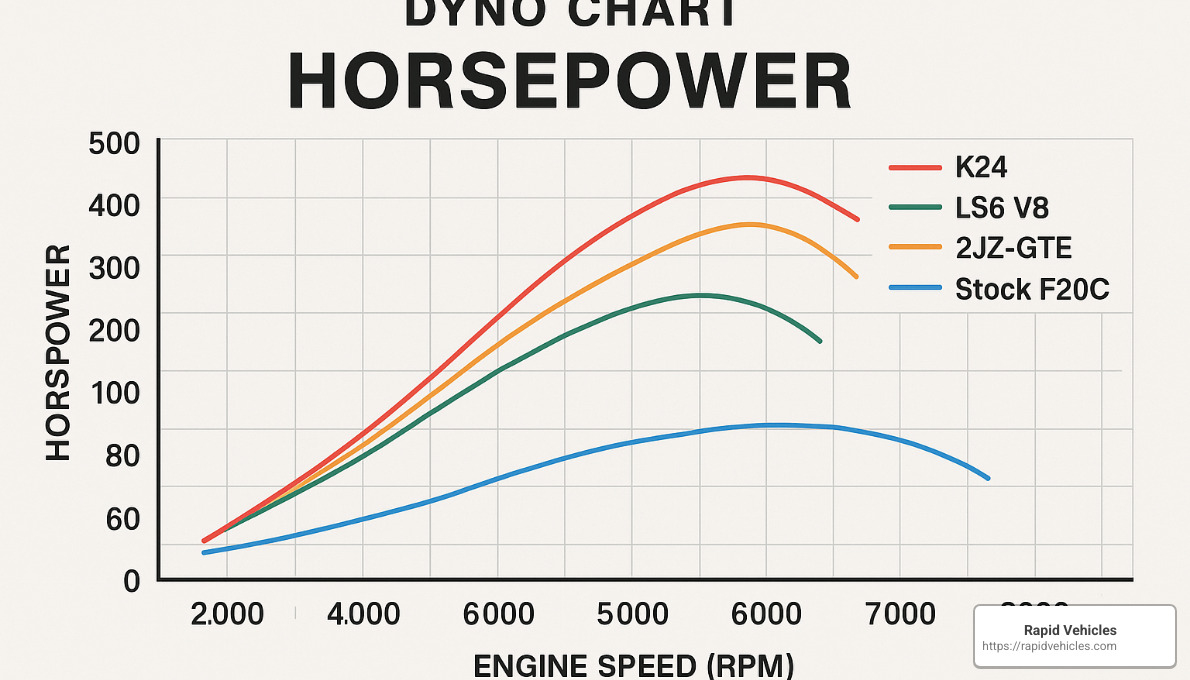
The K24 GLTC race build has become something of a legend in time attack circles. Using a K24A2 block paired with a K20 head, this naturally aspirated setup reliably produces 235 wheel horsepower—plenty in the lightweight S2000 chassis. What makes this build special isn't just the power, but the reliability. With thousands of hard track miles, these engines just keep singing. The secret? A properly baffled oil pan, headers designed specifically for the S2000 chassis, and meticulous tuning.
For those who crave American muscle, the LS6 street builds show how versatile the S2000 platform can be. One particularly well-executed example puts down 420 horsepower and over 400 lb-ft of torque through a T56 six-speed transmission. Despite the V8 up front, careful component selection maintained a perfect 50/50 weight distribution at just 3,040 pounds. The owner reports it "drives like a stock S2000 that someone strapped a rocket to."
At the extreme end, a few brave souls have stuffed Toyota's legendary 2JZ-GTE into the S2000's engine bay. One such build produces over 1,200 horsepower with a massive turbocharger. The owner switched to the 2JZ after blowing four F20 blocks in pursuit of big power. "The inline-six just takes the abuse and asks for more," he explained at a recent meet. "It's not the most practical swap, but nothing else could handle the power I wanted reliably."
Common Pitfalls to Avoid
Even experienced builders make mistakes, but you can learn from them rather than repeating them. Here are the most common issues that derail honda s2000 engine swap projects:
Starting with a questionable donor engine is perhaps the most expensive mistake you can make. As one shop owner told me, "Starting with the healthiest engine is the most important step—skip this and you'll be chasing problems forever." Always perform compression and leak-down tests before purchasing your donor engine. That $500 junkyard K24 might seem like a bargain until you're rebuilding it before it even goes into your car.
Wiring complexity catches many DIYers off guard. Modern engines rely on precise electrical connections, and shortcuts here lead to frustration. Invest in quality harness adapters or professional wiring services. One K-swap specialist shared, "Ninety percent of the 'mystery' problems I diagnose come down to wiring issues or ground problems."
Cooling system design requires careful thought, especially in the compact S2000 engine bay. Different engines have different cooling needs and flow patterns. Ensure your radiator is properly sized, hoses are routed without kinks, and the thermostat location makes sense for your specific setup.
Oil control for track use becomes critical when you're pushing the car hard through corners. "Horizontally mounted radiators and inadequate oil control lead to persistent issues until diagnosed," warned one track-day regular. The S2000's handling capabilities mean your oil system needs to be designed for high lateral G-forces.
Emissions requirements can't be ignored for street-driven cars. Many builders focus so much on performance that they neglect to maintain the emissions equipment required by law. This leads to failed inspections and potentially costly fixes down the road.
Community & Resources for honda s2000 engine swap
You're never alone on your engine swap journey. The S2000 community is incredibly supportive and full of knowledge.
Online forums like S2Ki.com have become treasure troves of information, with detailed build threads documenting every step of successful swaps. Honda-Tech.com offers broader Honda expertise that often applies directly to S2000 projects.
Facebook groups dedicated to specific swaps, like the K-swap S2000 Group, connect you with others working through the same challenges. Members often share parts sources, troubleshooting tips, and encouragement when things get tough.
YouTube has transformed how enthusiasts approach complex projects. Channels like Speed Academy offer detailed K-swap videos that walk you through the process step by step. Hoonigan features some of the wildest S2000 builds, including that 2JZ monster mentioned earlier.
Professional builders like Science of Speed offer complete swap packages, including their popular K20C1 (Civic Type R) conversion kit. ASM Motorsports has become known for their carefully engineered K-swap packages with proven reliability.
For specific parts guidance custom to your swap project, our team at RapidVehicles.com is always happy to help steer the sometimes overwhelming options. We've helped hundreds of S2000 owners find the right components for their dream builds, whether they're aiming for street, track, or a blend of both.
Frequently Asked Questions about honda s2000 engine swap
Will my stock S2000 transmission work with a new engine?
This is probably the most common question we hear from S2000 owners planning their first swap. The answer depends entirely on which engine you're installing.
If you're doing a K-series swap, you're in luck! Your stock S2000 transmission will work perfectly fine with an appropriate adapter plate. Companies like Inline Pro, 2NRS, and Ballade Sports make excellent quality adapter plates specifically designed for this purpose. They're precision-machined to ensure perfect alignment between your new K-series engine and the original S2000 gearbox.
For those considering an LS V8 swap, unfortunately, the stock transmission won't work. Most LS swaps use a T56 six-speed manual transmission from GM, which requires custom transmission tunnel modifications to fit in the S2000 chassis. This is one of the more involved aspects of an LS swap, but the reward is a bulletproof transmission that can handle all that V8 torque.
With J-series swaps, you can use your stock transmission with the proper adapter plate, though many owners tell us they eventually upgrade to stronger transmissions to handle the V6's increased torque. The stock S2000 transmission is robust, but wasn't originally designed for the torque levels a J35 can produce.
As one experienced builder shared with us: "Most aftermarket K-series flywheel/clutch solutions are manufactured by Competition Clutch or Clutch Masters. I've had great results with both brands in high-power applications."
How does a swap affect 50/50 weight distribution?
The S2000's near-perfect weight distribution is one of its most cherished handling characteristics. Naturally, many owners worry about disturbing this balance with an engine swap.
With a K-series swap, you'll see minimal impact on weight distribution. The K-series is actually slightly lighter than the original F-series, and its similar design means the weight remains distributed in roughly the same way. Most K-swapped S2000s maintain very close to the original balance.
Surprisingly, an LS V8 swap can maintain 50/50 weight distribution when properly installed. One LS-swapped owner we spoke with was delighted to report: "It still sits with 50/50 weight distribution and rides like it's on rails." The key is proper component placement and using aluminum-block LS engines rather than heavier iron-block versions.
A J-series swap will make your S2000 slightly more front-heavy, but the V6 configuration keeps the weight relatively compact compared to other six-cylinder engines. Most owners report minimal impact on handling characteristics.
The 2JZ swap tends to make the car more front-heavy due to the inline-six length and weight. This is one of the trade-offs for the massive power potential of the 2JZ platform.
The bottom line? Proper planning and component placement are key to maintaining good balance. Some builders add ballast to the rear when necessary, especially for competition vehicles where precise weight distribution is critical.
Can I keep air conditioning and power steering?
For those of us who use our S2000s on the street, comfort features like A/C and power steering aren't just luxuries—they're necessities.
With a K-series swap, you can absolutely retain both A/C and power steering with the proper brackets and hoses. Many quality K-swap kits include provisions for these systems, making the integration relatively straightforward. Since you're staying within the Honda family, many components are compatible or easily adapted.
If you're going with an LS V8 swap, air conditioning can be retained, but it requires custom bracket fabrication and hose adaptation. Power steering typically uses the LS pump system rather than the original S2000 setup. It's more work, but plenty of street-driven LS-swapped S2000s maintain full comfort features.
For J-series swaps, both systems can be retained with custom brackets and hoses. The J-series was designed for luxury vehicles like the Acura TL, so it's well-suited to maintaining comfort features.
The K20C1 Type R swap is a different story. According to product documentation, A/C is not supported in the race-oriented Type R swap package. This makes sense given its track-focused design.
For street-driven cars, we strongly recommend maintaining these comfort features if possible, especially if your S2000 sees daily use. Nothing ruins the joy of driving your freshly swapped S2000 faster than sweating through your shirt in summer traffic!
While it might be tempting to delete these systems to save weight or simplify the swap, you'll appreciate keeping them when using your car regularly. At RapidVehicles.com, we can help you source the right parts to maintain these creature comforts while still achieving your performance goals.
Conclusion
The honda s2000 engine swap journey represents more than just an engine replacement—it's a path to reimagining Honda's iconic roadster to match your personal vision. Whether you're facing the reality of a blown F-series engine, craving more mid-range torque for street driving, or chasing big horsepower dreams, there's a swap solution custom to your aspirations.
Among the options, the K-series swap has emerged as the people's champion for good reason. It delivers that extra torque the S2000 always yearned for while keeping things in the Honda family—a perfect balance of improved performance and relative simplicity. As one builder put it: "The K24 gives the S2000 the torque it always deserved without sacrificing that special Honda character."
For those with a hunger for raw power, the LS V8 and 2JZ swaps open doors to performance levels the original engineers never imagined possible. These more extreme options demand greater investment in both time and money, but the rewards can be extraordinary for those willing to commit.
Whatever path calls to you, successful swaps aren't just about bolting in a new engine. They're about creating a harmonious system where every component works together. The thoughtful builder considers cooling, fueling, electronics, and driveline strength as part of a cohesive whole. As one veteran swapper wisely observed: "With enough determination and money, you can make any engine fit. The real challenge is creating a car that's as reliable and enjoyable as it is powerful."
At RapidVehicles.com, we understand these challenges intimately. Our inventory includes the specialized components that transform an engine swap from a garage nightmare into a rewarding project—from cooling system upgrades to the electronics that make everything play nicely together. Our team has helped countless builders steer the complexities of these conversions, and we're always ready to point you toward solutions that ensure both performance and reliability.
The perfect engine for your S2000 isn't necessarily the one with the biggest power numbers—it's the one that creates the driving experience that makes you smile every time you turn the key. With thoughtful planning and quality components, your S2000 can emerge from its change not just with more grunt, but as a more complete and personal expression of what a sports car should be.
After all, isn't that what the S2000 has always been about? Not just numbers on a spec sheet, but the feeling it creates when the road opens up ahead of you. Your engine swap is simply the next chapter in your S2000's story—make it a good one.