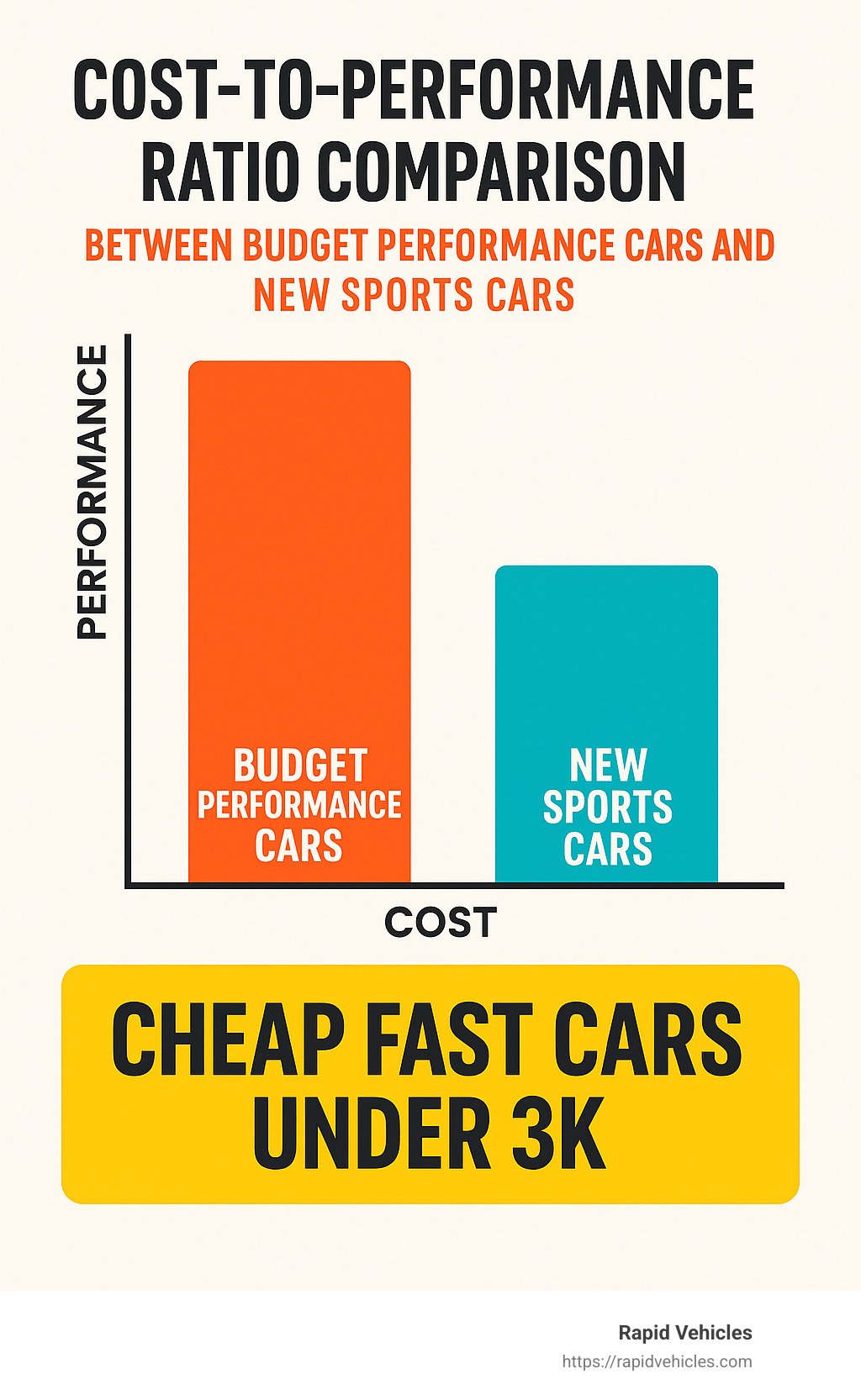
Zoom for Less Room in Your Wallet: Cheap Fast Cars Under 3K
Finding Speed on a Shoestring Budget

Remember when $1,000 could buy you a decent set of wheels? Those days might be in our rearview mirror, but don't despair – the thrill of affordable performance isn't dead yet. Even in 2025's inflated market, cheap fast cars under 3k still exist for those willing to hunt.
The magic happens in what I like to call the "depreciation sweet spot." These are vehicles that once commanded premium prices but have now fallen into the budget-friendly zone – not because they're junk, but simply because the market has moved on. Their loss is our gain!
What makes a car "fast" is subjective, of course. At this price point, we're looking for machines that deliver genuine excitement – whether through raw horsepower, lightweight nimbleness, or that perfect balance of both. As one seasoned Car Throttle forum member put it: "You could do it in anything really. How about a mk5 golf gti, or even a diesel GT?" The beauty lies in finding your personal definition of fun.
Here's what's currently available for budget speed demons:
| Model | Typical HP | 0-60 Time | Common Price |
|---|---|---|---|
| Ford Mustang (94-04) | 215-260 hp | 6.5-7.2s | $2,500-3,000 |
| Mazda Miata (90-05) | 116-140 hp | 7.9-8.5s | $2,800-3,000 |
| Nissan Maxima (00-03) | 255 hp | 6.2s | $2,300-2,900 |
| Infiniti G35 (high miles) | 280-298 hp | 5.5-6.0s | $2,700-3,000 |
| Chevrolet Camaro (93-02) | 200-305 hp | 5.7-7.0s | $2,500-3,000 |
When shopping in this price bracket, condition trumps everything else. A well-maintained 150,000-mile car will almost always treat you better than a neglected 80,000-mile "cream puff" with suspicious history gaps. Look for service records, honest owners, and signs of regular maintenance.
The secret to finding these affordable speed machines isn't just luck – it's patience and knowledge. Many of these cars have been unfairly written off due to perceived repair costs rather than actual reliability issues. Their undervalued status creates golden opportunities for savvy buyers who know what to look for.
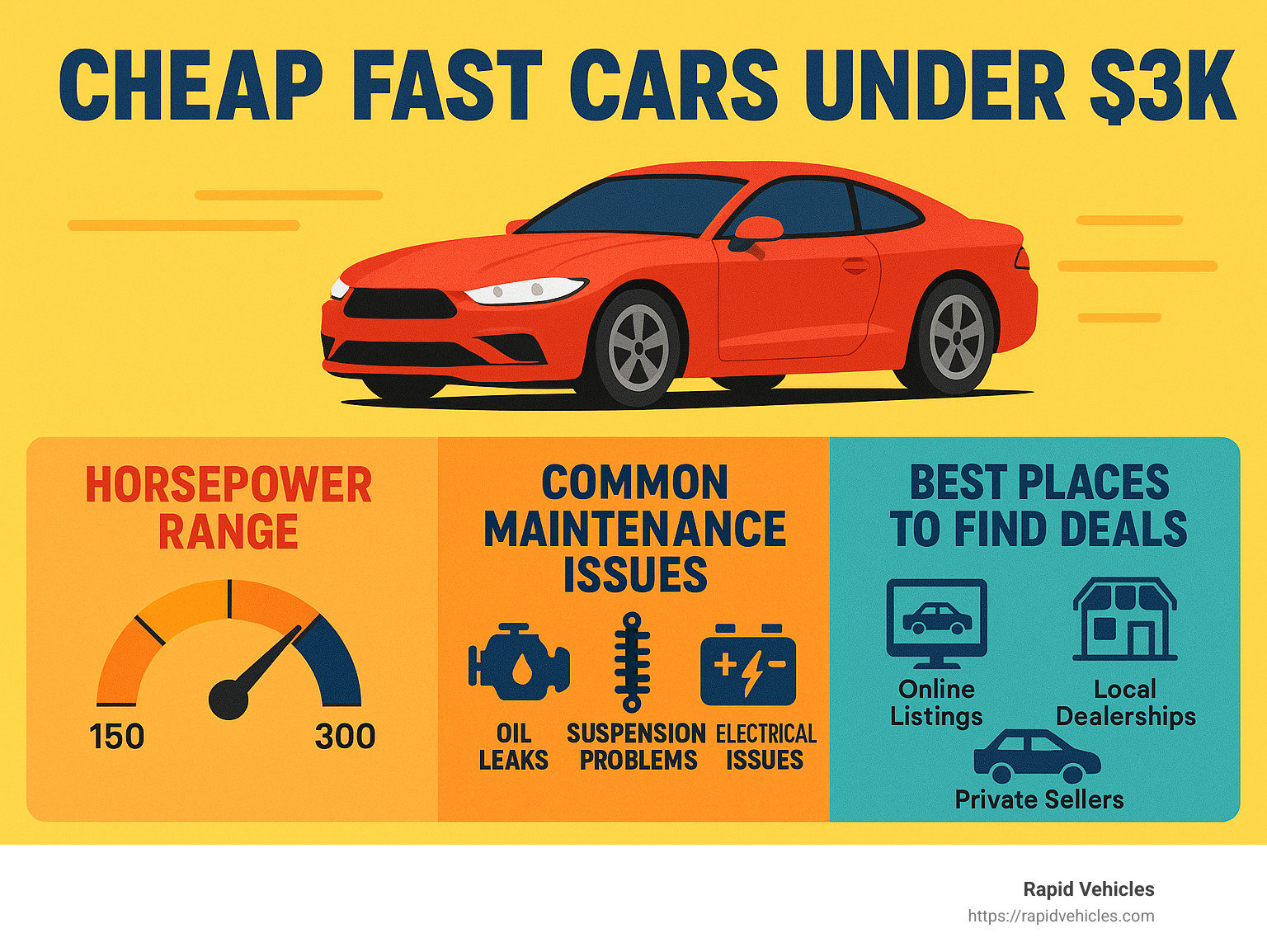
The economic challenges of recent years pushed used car values into the stratosphere, but that doesn't mean the dream of affordable performance is dead. With some homework and a bit of elbow grease, you can still find that perfect balance of price and performance – a car that delivers grins per dollar in a way no monthly payment on a new vehicle ever could.
What Defines a Cheap Fast Car Under $3K?
Finding genuine performance on a tight budget might sound impossible in today's market, but cheap fast cars under 3k still exist for those who know where to look. But what exactly counts as "fast" when you're working with three grand or less?
For our budget speed hunters, we're targeting cars that deliver a genuine thrill—typically hitting 0-60 mph in under 8 seconds (and ideally closer to 7 seconds). Most will pack between 150-220 horsepower, though some hidden gems offer even more punch under their hoods.
The sweet spot for these affordable speedsters usually includes a clean title. While salvage titles might tempt you with even lower prices, they're best avoided unless you're already a seasoned wrench-turner. Mileage-wise, staying under 200,000 miles is ideal, though many Japanese and domestic performance models remain surprisingly reliable well beyond this mark.
Drivetrain matters too. Rear-wheel drive delivers that classic performance feel with balanced handling and drift potential, while front-wheel drive options often provide more practical all-season usability. All-wheel drive tends to command a premium even on older vehicles, pushing many beyond our strict $3k ceiling.
Manual transmissions are the enthusiast's choice in this bracket—not just for the engagement factor, but because they're often simpler and less expensive to repair than their automatic counterparts. Plus, rowing your own gears makes even modest horsepower feel more exciting.
Many of the best performance bargains come in "sleeper" packaging—understated looks hiding surprising capability. These unassuming vehicles often depreciate faster than their flashier counterparts, creating perfect opportunities for budget-minded enthusiasts.
As automotive writer Brady Holt notes, "When a car is worth less than $3,000, the free market has written it off as undesirable—often due to perceived repair costs rather than actual reliability." This market perception creates a golden opportunity for those willing to research and take calculated risks.
What's truly remarkable is how many vehicles that originally commanded $25,000-$40,000 price tags now sell for literal pennies on the dollar. These depreciation curves bring genuine performance within reach of almost any budget—you just need to know which models offer the best balance of speed, reliability, and affordability.
Cheap Fast Cars Under 3K: Buyer Checklist
Shopping for cheap fast cars under 3k is like treasure hunting – thrilling but requiring a keen eye to separate the gems from the junk. Before you hand over your hard-earned cash, arm yourself with this practical checklist.
First things first – always budget $100-150 for a pre-purchase inspection. This might seem like an extra expense when you're already stretching your budget, but trust me, it's the best insurance against buying someone else's nightmare. A good mechanic can spot issues that might cost you thousands down the road.
Rust is the silent killer of budget performance cars. Take your time examining wheel wells, rocker panels, and trunk floors – these areas tell the true story of a car's life. I once saw a Miata that looked pristine from ten feet away but had floors you could put your foot through!
Timing belt history is absolutely critical. Many sellers will claim "regular maintenance" but get suspiciously vague when you ask specifically about timing belt replacement. This $450-800 job can prevent a catastrophic engine failure, so verify if and when this service was performed.
Before falling in love with that V8 Mustang, call your insurance company. Some performance models carry surprisingly high premiums even when the purchase price is low. I've seen buyers forced to sell their dream car a month after purchase because they couldn't afford the insurance.
Research parts availability and pricing before buying. That $2,500 G35 might seem like a steal until you find certain components can only be sourced from the dealer at premium prices.
| Model | Average List Price | Common Repair Cost |
|---|---|---|
| Ford Mustang V6 | $2,700 | $650 (intake manifold) |
| Mazda Miata | $2,900 | $450 (timing belt kit) |
| Nissan Maxima | $2,500 | $800 (clutch replacement) |
| Chevrolet Camaro V6 | $2,600 | $550 (fuel pump) |
| Infiniti G35 | $2,900 | $750 (wheel bearings) |
Service records are worth their weight in gold in this price range. As one forum member perfectly put it: "The difference between a bargain and a money pit often comes down to the previous owner's maintenance habits." I once saw a stripped-down Camaro where the "previous owner had the rear seats sitting in the paddock along with wheels and the jack! 😂" – not exactly a sign of careful ownership!
During the test drive, use all your senses. Listen for unusual noises, feel for transmission issues, and test the brakes firmly (when safe). Budget cars will rarely be perfect, but major driveline issues should be deal-breakers.
Where to Spot Real-Time Deals
Finding these elusive cheap fast cars under 3k requires knowing where to look and how to search efficiently. Craigslist remains a goldmine if you use specific filters – try searching "manual V8" or "sports package" instead of just the model name.
Facebook Marketplace has quickly become my favorite hunting ground, often featuring cars that never make it to traditional listing sites. The messaging feature makes quick communication easy, and there's typically less competition than on more established platforms.
Don't overlook local auctions. Government and police auctions occasionally yield amazing performance bargains, especially when the vehicles don't fit the typical family-car profile that most bidders want.
Owner forums are where the real enthusiasts hang out. These sellers typically know exactly what they have and have often maintained their vehicles carefully. You might pay closer to the full $3,000, but you'll generally get a much better example.
Set up alerts for specific models with price caps on multiple platforms. Many sellers don't know what they have or need to sell quickly due to life circumstances, creating perfect opportunities for informed buyers.
For more insights on finding exceptional deals on performance vehicles, check out Supercar News for the latest market trends and buying advice.
1. Ford Mustang SN95 / "New Edge" (1994-2004)
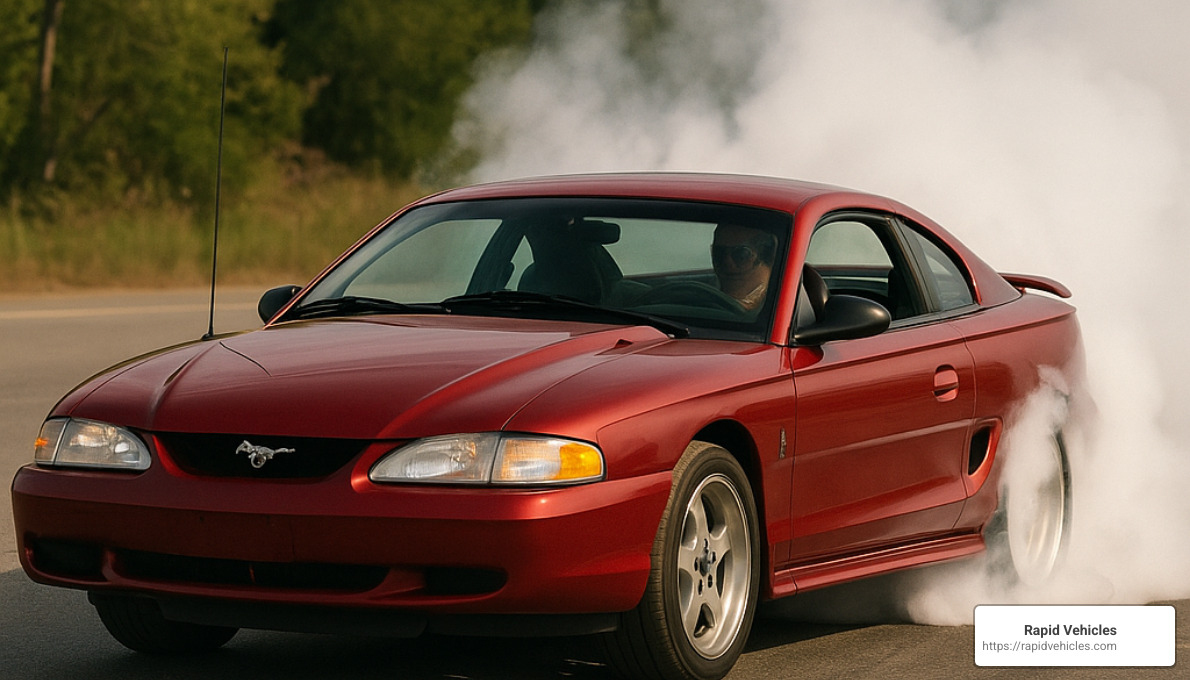
Ask any gearhead about cheap fast cars under 3k, and the Ford Mustang SN95 will likely top their list. This affordable American icon delivers that quintessential muscle car experience without emptying your wallet.
The 1994-2004 Mustangs come in two distinct flavors: the earlier, smoother SN95 design and the sharper, more aggressive "New Edge" refresh that arrived in 1999. Under the hood, you'll find either the budget-friendly 3.8L V6 pushing out a respectable 190-193 hp or the more desirable 4.6L V8 with 215-260 hp depending on the year and trim.
While V8 GT models command premium prices, plenty of V6 examples still deliver that pony car thrill while staying comfortably under our $3,000 ceiling. These V6 models often surprise new owners with their peppy performance and are frequently found with lower miles and better overall condition.
"My first SN95 was a V6 automatic I bought for $2,700," shares one enthusiast. "It wasn't the fastest thing on the road, but man, the sound and feel of that car made every drive special."
What makes these Mustangs particularly attractive is their mechanical simplicity. Even if you're new to wrenching, the engine bay offers plenty of space to work, and most maintenance can be handled with basic tools. The solid rear axle design, while sometimes criticized for its handling limitations, provides both durability and an authentic muscle car feel that's increasingly rare in modern vehicles.
Parts availability is another major advantage. From routine maintenance items to performance upgrades, the aftermarket support is absolutely massive. Want more power? Bolt-on modifications like cold air intakes, exhaust systems, and even boostr kits are readily available and well-documented.
However, these budget stallions aren't without their quirks. Watch for plastic intake manifold failures on 1996-2001 models – a common issue that typically manifests as coolant leaks. A distinctive rear-end whine often signals differential wear, while clutch cable issues plague manual transmission models. And like many American cars of this era, rust in the quarter panels and floor pans can be problematic in regions that use road salt.
The convertible variants deserve special mention for those seeking open-air thrills. While slightly heavier than their hardtop counterparts, they offer an experience that few cars in this price range can match – just be sure to check the top operation thoroughly and inspect for any water damage.
As one satisfied owner put it: "If you can't do a burnout in a Mustang, there's no hope for you." With its iconic styling, straightforward mechanicals, and the unmistakable rumble of American muscle, the SN95 Mustang remains one of the most accessible entries into genuine performance car ownership.
2. Mazda MX-5 Miata NA/NB (1990-2005)
The Mazda Miata has become the quintessential affordable sports car, and early examples (NA 1990-1997 and NB 1999-2005) can still be found under our $3,000 budget with some patience and searching.
With only 116-140 hp from its 1.6L or 1.8L engines, the Miata isn't winning any drag races, but as enthusiasts often say, "You don't buy a Miata because it's fast. You buy it because you enjoy the act of driving."
Why it's great:
- Perfect 50/50 weight distribution
- Sublime handling characteristics
- Simple, reliable mechanics
- Huge enthusiast community
- Manual soft-top for open-air fun
Watch out for:
- Rust in rocker panels and rear wheel arches (deal-breaker)
- Timing belt service history (critical)
- Soft top condition (expensive to replace)
- Short nose crank issues on 1990-1991 models
The Miata epitomizes the "slow car fast" philosophy—it's more fun to drive a slow car at its limits than a fast car at half its potential. With its lightweight chassis (just over 2,100 lbs), even modest power feels zippy and engaging.
As one CarBuzz writer explained, "A Miata may not be fast, but it feels fast. It's the ultimate feel-good toy and will improve every commute or journey you undertake."
3. Chevrolet Camaro 4th Gen (1993-2002)
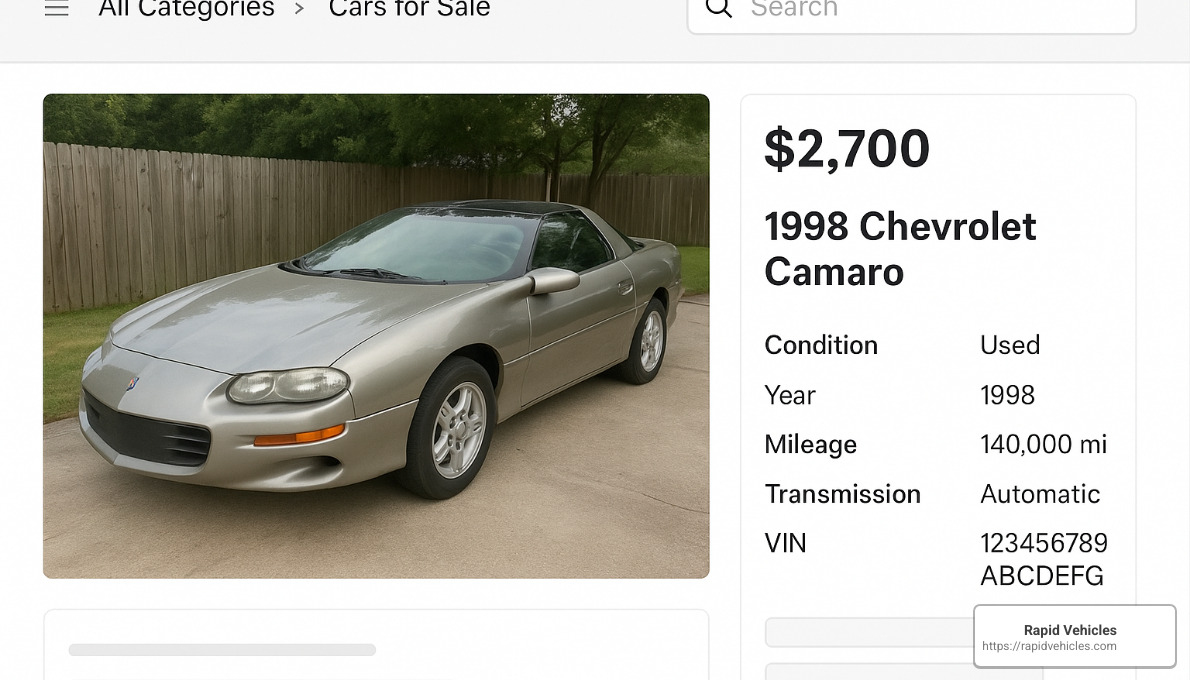
The fourth-generation Camaro is the muscle car that time forgot – and that's great news for anyone hunting cheap fast cars under 3k. These F-body beasts offer that classic American performance feel without draining your wallet completely dry.
Early '90s models came equipped with either the 3.4L V6 pushing a respectable 160 hp or the more desirable 5.7L LT1 V8 with a smile-inducing 275 hp. If you're lucky enough to find later models in your price range, you'll enjoy either the improved 3.8L V6 (200 hp) or the holy grail: the LS1 V8 packing 305-325 hp of tire-shredding potential.
Finding an LS1-powered Camaro under three grand requires patience and flexibility. You'll likely need to accept higher mileage (think 150k+) or overlook some cosmetic battle scars. But even the V6 models deliver a surprising punch, especially when paired with a manual transmission.
Why Camaro lovers swear by them:
These cars deliver genuine muscle car thrills with their long hood, rear-wheel drive layout, and unmistakable 90s styling. The T-tops (when they don't leak) provide an open-air experience that's perfect for summer cruising. And unlike many cars on our list, the Camaro still looks fast even when parked.
The F-body community remains incredibly strong, with forums full of helpful enthusiasts sharing maintenance tips and modification advice. As one dedicated owner put it, "The LS1 is basically the small-block Chevy of our generation – simple, powerful, and it responds to everything you throw at it."
Common issues to check before buying:
Pay close attention to the Optispark distributor on LT1 engines – these are notorious failure points and should be on your immediate inspection list. The clutch hydraulic system tends to develop problems, so test the clutch feel carefully during your test drive.
Those beloved T-tops often develop leaks that can lead to interior water damage and electrical gremlins. Speaking of electrics, test every switch, button and feature during inspection. Finally, listen for clunks from the suspension – these cars are often driven hard, and bushings wear out accordingly.
Subframe connectors are a popular and worthwhile upgrade, as they stiffen the somewhat flexible chassis. Many owners consider them essential for both performance and longevity.
Despite their age, these Camaros offer reasonably modern safety features and enough comfort to serve as occasional daily drivers. But their true purpose is clear every time you press that accelerator – delivering affordable American performance that still turns heads nearly three decades later.
4. Buick Regal GS (1997-2004)
The automotive world is full of surprises, and the Buick Regal GS might be one of the best-kept secrets in the cheap fast cars under 3k universe. This unassuming sedan packs a serious punch thanks to its boostd 3800 Series II V6 engine. With 240 horsepower and a meaty 280 lb-ft of torque, this comfortable four-door can hustle from 0-60 in about 6.5 seconds—not too shabby for something that looks like it belongs in your grandpa's driveway!
What makes the Regal GS special is its Jekyll and Hyde personality. On the outside, it's all business—conservative styling, chrome accents, and a respectable profile that won't raise eyebrows at the office. But stomp on the gas pedal, and you'll feel that boostr whine as it delivers a surprising rush of acceleration that catches most drivers completely off guard.
Why enthusiasts love the Regal GS: The sleeper factor is off the charts with this Buick. Nobody expects a fast Buick sedan, which means you'll enjoy countless "what was that?" moments at stoplights. Inside, you're treated to comfortable leather seating that puts many modern cars to shame. The ride quality strikes that perfect balance between comfort and control that GM somehow nailed with these models.
The 3800 engine is practically bulletproof when maintained properly, and parts are plentiful and affordable. Even better, the performance aftermarket has acceptd these cars. A simple pulley swap on the boostr can boost output to well over 270 hp for less than $200 in parts—making it one of the most cost-effective power upgrades in the automotive world.
When shopping for a Regal GS, pay special attention to the transmission fluid condition. These cars can develop shifting issues if the fluid hasn't been changed regularly. Also inspect for intake manifold gasket failures—a common issue that's not expensive to fix but can cause headaches if neglected. Boostr bearings can wear over time, so listen for any unusual whining noises during your test drive.
As one owner put it in a forum post: "My Regal GS is the ultimate dad-mobile sleeper. I've embarrassed countless Mustang and Camaro owners who never saw it coming from a 'boring' Buick."
For buyers who need four doors and everyday comfort but still crave performance thrills, the Regal GS represents perhaps the best value proposition in the entire cheap fast cars under 3k category. It's the practical performance car that nobody thinks to look for—and that's exactly what makes it special.
5. Nissan Maxima 3.5 SE (2000-2003)
Ah, the Nissan Maxima - Nissan's bold claim of creating a "four-door sports car" might raise eyebrows, but the 2000-2003 generation actually delivers on this promise. These years represent a sweet spot in the cheap fast cars under 3k market that many enthusiasts overlook.
Powered by the legendary VQ35DE V6 engine pumping out a healthy 255 horsepower, these sedans can hustle from 0-60 in just over 6 seconds when properly maintained. That's genuine sports car territory wrapped in practical family sedan packaging!
The holy grail in this category is finding one with the 6-speed manual transmission. These unicorns transform the driving experience completely, letting you wring every ounce of performance from that silky-smooth V6. While increasingly rare, patient shoppers can still occasionally uncover these gems under our $3,000 budget ceiling.
What makes the Maxima special is how it balances multiple personalities. During the week, it's a comfortable, spacious sedan that won't draw unwanted attention. Come the weekend, find a twisty road, drop a gear or two, and you'll find why enthusiasts hold the VQ engine family in such high regard.
Why the Maxima deserves your attention:
The VQ35 engine is remarkably robust when maintained properly. Many examples have sailed past 200,000 miles with basic care, a testament to Nissan's engineering during this period. The interior features supportive seats and decent materials that have generally aged better than competitors from the same era.
For the mechanically inclined, these Maximas offer solid modification potential. A limited-slip differential swap from similar Nissan platforms can dramatically improve handling characteristics, while simple intake and exhaust modifications can coax additional horsepower from the already willing V6.
Keep your eyes and ears open for:
Listen carefully for timing chain tensioner noise during test drives - a telltale ticking that intensifies with RPM is your warning sign. Transmission mounts commonly fail, creating vibrations and notchy shifting. Mass airflow sensors and oxygen sensors frequently need replacement, but fortunately, these repairs are relatively straightforward and parts are readily available.
The Maxima represents that perfect middle ground in the cheap fast cars under 3k segment - practical enough for daily duties yet spirited enough to put a smile on your face when the road opens up. As one owner eloquently put it, "It's the mullet of cars - business in the front, party in the back."
For families or those needing real backseat space who refuse to give up performance, few options deliver this much fun for so little investment. Just be prepared to become that friend who's always surprising muscle car owners at stoplights!
6. Infiniti G35 Coupe (2003-2007 high-mile)
Finding a G35 Coupe under $3,000 requires some compromise, typically in the form of higher mileage (often 150,000+ miles) or cosmetic imperfections. However, these Nissan 350Z-based luxury coupes offer tremendous value for performance enthusiasts.
Powered by a 280-298 hp version of the VQ35 V6 and built on Nissan's Front Midship (FM) platform, the G35 delivers near-BMW levels of performance with better reliability and lower maintenance costs.
Why it's great:
- Powerful VQ35 V6 engine (280-298 hp)
- Balanced rear-wheel-drive chassis
- Available with Brembo brakes
- Upscale interior with modern amenities
- Handsome, timeless styling
Watch out for:
- Oil consumption issues (check carefully)
- Worn suspension bushings
- Clutch wear on manual models
- Rear wheel bearing failures
- Dashboard bubbling/cracking
The G35 shares much of its DNA with the Nissan 350Z but adds practicality with its small rear seats and more refined interior. As one forum enthusiast explained, "The G35 is basically a 350Z in a suit."
High-mileage examples can still provide years of enjoyable service with proper maintenance, making them one of the best performance values in the cheap fast cars under 3k category.
7. Volvo V70 R (2004-2007)

The Volvo V70 R is the ultimate wolf in sheep's clothing for the budget-conscious speed demon who still needs to haul the kids to soccer practice. These Swedish sleepers pack a serious punch with their 300 hp turbocharged five-cylinder engines that sing a distinctive, almost musical exhaust note you'll never forget.
Finding one of these rare wagons under our cheap fast cars under 3k threshold requires some patience and compromise. You'll likely be looking at examples with odometer readings north of 200,000 miles or ones needing some mechanical TLC. But don't let that scare you off – these Volvos were built to last, and many are still running strong well into high mileage territory.
Why enthusiasts love them: The V70 R delivers a unique blend of practical wagon utility with genuine performance credentials. The all-wheel-drive system provides year-round traction while the turbocharged engine launches this family hauler to 60 mph in about 6 seconds flat. That's quick enough to surprise many dedicated sports cars at stoplights!
The interior is another highlight, featuring some of the most comfortable seats ever installed in an automobile. The supportive bolsters hold you in place during spirited driving while remaining plush enough for long road trips. Plus, with that cavernous cargo area, you can haul everything from IKEA furniture to camping gear without breaking a sweat.
Watch your wallet for: These performance Volvos do come with some specific issues to check before buying. The angle gear (which transfers power to the rear wheels) is a known failure point and can be expensive to repair. The electronic throttle module sometimes acts up, and the sophisticated Four-C adjustable suspension can develop problems that aren't cheap to fix.
Always verify the timing belt service history – this is an interference engine, meaning a broken belt can destroy the motor. The PCV system is another trouble spot, so listen for any whistling noises that might indicate problems.
"Nobody expects to be smoked by a boxy Volvo wagon," one enthusiast told me at a car meet. That sleeper status is perhaps the V70 R's greatest charm – it's the automotive equivalent of a professor who moonlights as a UFC fighter.
These Swedish rockets require premium fuel and regular maintenance, but they reward owners with a truly unique driving experience. Where else can you find all-wheel-drive, turbocharged performance with room for five adults and their luggage – all for less than three grand? Just be prepared to explain to confused onlookers why your family wagon has Brembo brakes and a boost gauge.
Mods & Upgrades to Keep Things Fast for Less
So you've finally found that perfect cheap fast car under 3k? Congratulations! But the fun doesn't stop at the purchase—there's a whole world of affordable upgrades that can make your budget speed machine even more thrilling without emptying your wallet.
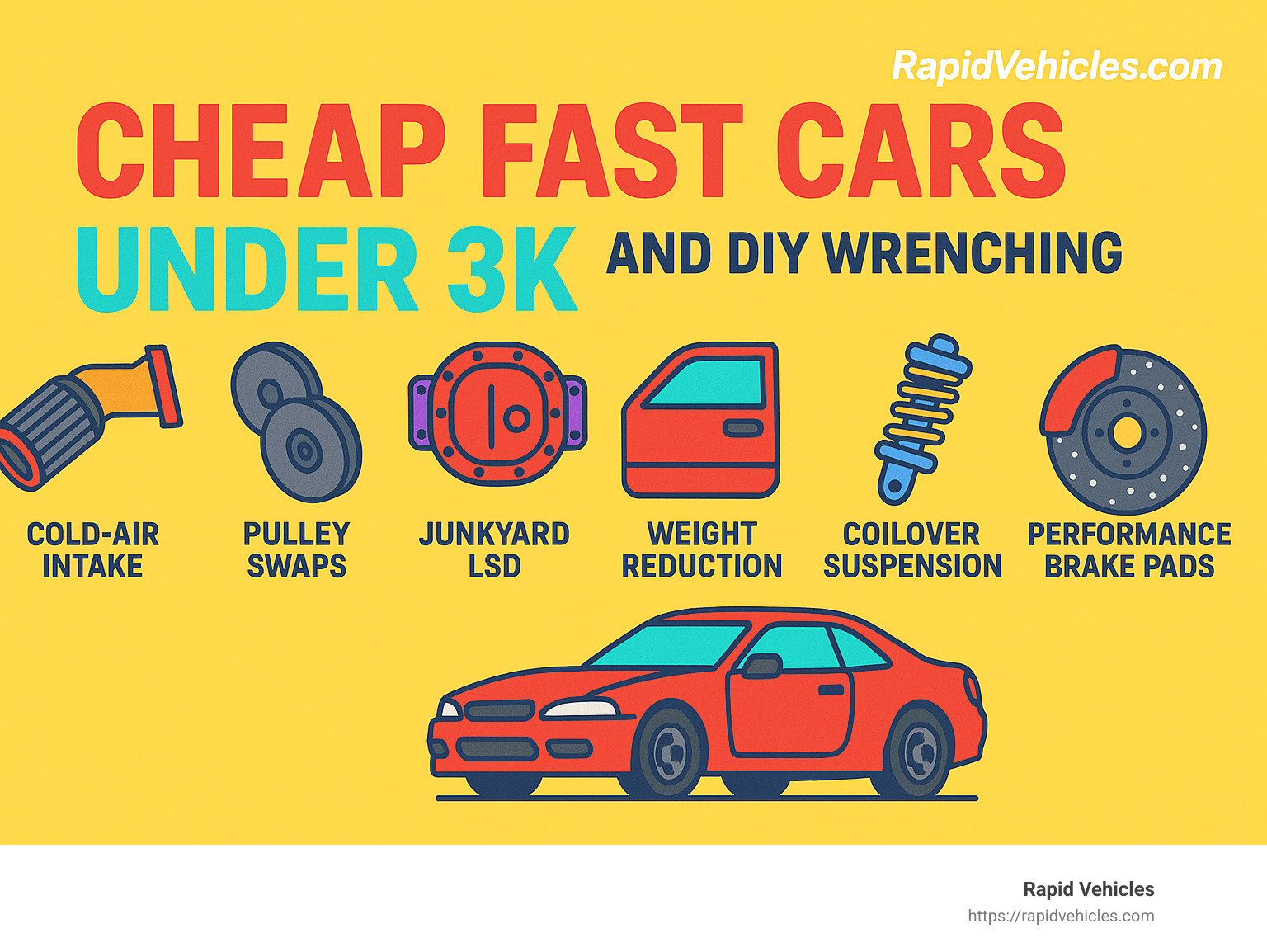
A cold-air intake is often the gateway modification for many enthusiasts. For just $150-300, you can gain 5-10 horsepower and enjoy a more responsive throttle feel. Plus, that distinctive intake sound adds to the driving experience! As my friend Jake likes to say about his modified Miata, "Half the fun is hearing that intake gulp air when I stomp on it."
For forced-induction cars like the Buick Regal GS or Volvo V70 R, a simple pulley swap can work wonders. Smaller boostr pulleys or lightweight underdrive pulleys typically cost just $100-200 but can transform how your engine delivers power. Just remember that more boost means more heat—always monitor your temperatures after these modifications.
Nothing improves the driving dynamics of a rear-wheel-drive car quite like a limited-slip differential. While new units are expensive, junkyard hunting can score you an LSD for $200-400 (plus installation if you can't DIY). The difference is night and day, especially in cars like the Mustang or Miata, where the stock open differential can leave you one-wheel-peeling out of corners.
Weight reduction might sound cliché, but it's free and effective. Every 100 pounds shed improves acceleration, braking, and handling. Start with removing unnecessary items like unused rear seats, spare tires (replace with a repair kit), and sound deadening material. Just don't go overboard and compromise safety or comfort you actually need.
Suspension upgrades bring some of the best bang-for-buck improvements. A set of quality coilovers ($400-800) can transform a wallowy family sedan into a corner-carving machine. Even more affordable are stiffer sway bars and refreshed bushings, which can eliminate slop in older suspensions without breaking the bank.
Performance brake pads provide meaningful stopping power improvements without the expense of caliper upgrades. For $80-150, you can enjoy better pedal feel and more consistent performance, especially during spirited driving. As one track-day instructor told me, "Better brakes let you go faster everywhere else on the track."
Cheap Fast Cars Under 3K and DIY Wrenching
One of the greatest joys of owning cheap fast cars under 3k is getting your hands dirty. These older machines were built in an era when manufacturers still expected owners to perform basic maintenance. Without complex computers and proprietary systems, they're perfect for learning mechanical skills.
All you really need is a basic socket set, some wrenches, screwdrivers, and an OBD-II scanner (about $30 these days). YouTube has become an incredible resource for DIY mechanics, with detailed tutorials for almost any repair or modification you can imagine.
The forums dedicated to specific models are goldmines of information. When I was struggling with a fuel system issue on an old Camaro, it was a forum thread from 2009 that finally provided the solution. These communities are passionate about keeping these affordable classics on the road.
There's something deeply satisfying about fixing and improving your own car. As Tim, a dedicated Miata enthusiast, told me at a recent car meet: "I learned more from my $2,500 Mustang project than I did in two years of automotive classes. And unlike school, I was actually excited to learn."
Cheap Fast Cars Under 3K vs New Performance Cars
Modern performance cars are technological marvels—faster, safer, and more efficient than ever before. So why do so many enthusiasts still gravitate toward these older, simpler machines?
The answer lies in the driving experience. New cars insulate you from the road with layers of sound deadening, electronic assists, and drive-by-wire systems that filter your inputs. In contrast, these analog machines provide immediate, unfiltered feedback. You feel every imperfection in the road, hear the engine's genuine voice, and develop a mechanical sympathy that's impossible to replicate in newer vehicles.
There's also something liberating about driving a car that you're not afraid to use hard. When your entire vehicle cost less than the depreciation hit on driving a new sports car off the lot, you're more likely to enjoy it without worry. As one forum member eloquently put it: "I don't stress about rock chips or parking lot dings. I just drive the thing and enjoy it."
The cost-to-smile ratio heavily favors these budget performers. A $3,000 Miata or Mustang can deliver more pure driving enjoyment than many new cars costing ten times as much. It's not about impressing others—it's about the grin that spreads across your face when you nail a perfect downshift or carve through a familiar corner. For more insights on this philosophy, check out Jalopnik's take on affordable driving enjoyment.
Running Costs: Insurance, Fuel & Reliability
Let's talk about what really matters after you've scored that dream ride - keeping it on the road without emptying your wallet! Owning a cheap fast car under 3k involves more than just the initial purchase price.
Insurance costs can vary dramatically depending on your chosen speed machine. Many performance models naturally carry higher premiums, but there are some surprises in this category. Japanese imports like the Miata or Maxima often have reasonably affordable rates, while American V8 muscle might get slapped with "high risk" classifications regardless of your spotless driving record.
"My insurance actually went DOWN when I switched from my Civic to my Miata," shares one forum member. "The insurance company considered it a 'weekend toy' rather than a 'street racer' like they did the Civic."
Going with liability-only coverage can keep your monthly costs manageable, though it does leave your precious new-to-you ride vulnerable if accidents happen. For cars in this price range, this is often the sensible choice, especially if you've got some mechanical skills.
When it comes to fuel economy, there's usually a tradeoff between fun and frugality. Those V8 Mustangs and Camaros will typically return 15-20 mpg combined, while the nimble Miata can stretch to 25-30 mpg with careful driving. Worth noting - many turbocharged options like the Volvo V70 R insist on premium fuel, which adds up over time.
One owner of a 2002 Camaro V6 noted: "It's not going to win any efficiency awards, but it's actually not terrible on highway trips. Just don't mash the gas pedal everywhere you go!"
Reliability is where many budget performance cars shine brighter than their reputation suggests. Japanese options including the Miata, Maxima, and G35 tend to be the workhorses of the group, often sailing past 200,000 miles with basic maintenance. American muscle cars feature simple, robust mechanical designs but might need more frequent attention to smaller issues. European models like the Volvo carry higher maintenance costs when things break, but can deliver surprising durability when properly cared for.
Parts availability and cross-compatibility are huge advantages for many of these vehicles. Ford Mustang components, for example, are shared across multiple generations, keeping prices reasonable and parts readily available. Even for the more exotic choices, companies like Rapid Vehicles offer quality replacement and performance parts that won't break the bank.
The DIY-friendly nature of most cheap fast cars under 3k means you can often handle routine maintenance yourself, further reducing operating costs. A basic toolset and some YouTube tutorials can save hundreds in labor costs annually.
"I bought my G35 with 165,000 miles three years ago," shares one enthusiast. "It's now at 210,000 and still pulls hard. These cars were overbuilt from the factory."
Preventive maintenance is always cheaper than emergency repairs. Budgeting $500-1,000 annually for maintenance and repairs is wise for most vehicles in this category, with European models typically falling toward the higher end of that range. For more detailed reliability ratings on specific models, Consumer Reports offers valuable insights, though you'll need to adjust expectations for the age and price point we're discussing.
With smart ownership practices and a willingness to turn a wrench occasionally, keeping your budget performance car on the road can be surprisingly affordable – leaving more funds for the fun stuff like modifications and track days!
Frequently Asked Questions About Cheap Fast Cars Under 3K
Are there really reliable, fast cars left under $3K?
Yes, these automotive unicorns do exist! The market in 2025 still has over 1,700 vehicles listed nationwide under the $3,000 mark. Finding them isn't about luck—it's about strategy and patience.
When hunting for cheap fast cars under 3k, condition trumps everything else. A well-maintained 180,000-mile car often delivers a better ownership experience than a neglected 120,000-mile example with mysterious gaps in its service history.
I recently spoke with a forum member who shared some golden advice: "Check service history thoroughly, especially cambelt and gearbox condition. Take time inspecting the shell for rust and always buy the best-condition example within your budget." This approach has saved countless enthusiasts from expensive headaches.
Most cars in this price range will need some attention, but the right one won't need immediate major repairs. For more detailed insights on finding reliable used cars, Edmunds offers an excellent guide to the used car buying process.
Manual or automatic—what's better for performance at this price?
For pure performance value in the cheap fast cars under 3k category, manual transmissions typically win hands down. They offer more direct control, better acceleration through optimized gear ratios, and that intangible connection between driver and machine that enthusiasts crave.
Manuals also tend to be simpler mechanically, making them less expensive to maintain and repair. As a bonus, manual-equipped performance cars often hold their value better when it's time to sell.
That said, some models buck this trend. The Ford Mustang's automatic transmissions are surprisingly capable, and high-traffic areas might make an automatic more livable for daily use. As one enthusiast colorfully noted about certain automatic transmissions, "The Tiptronic is better off forgotten"—a sentiment that applies to many budget-friendly performance cars with early automatic gearboxes.
The best transmission ultimately depends on your driving environment and personal preferences. Just remember that finding a manual-equipped performance car often requires more searching but rewards with a more engaging driving experience.
What hidden issues should buyers budget for immediately?
Even the most pristine cheap fast cars under 3k will likely need some attention soon after purchase. Smart buyers set aside funds for:
Cooling system refreshes are often overlooked but critical—budget $150-300 for hoses, thermostat, and possibly a water pump. Suspension bushings typically show their age in this price range, with replacement costing $200-500 depending on the vehicle. Don't forget about tires! Budget performance vehicles often wear budget tires (or worse, mismatched sets), so set aside $400-600 for decent rubber.
Timing belts or chains represent another potential expense ($300-800) that can't be ignored, while brakes ($200-400) are both safety-critical and frequently neglected on budget performance cars.
As automotive writer Brady Holt insightfully observed, "When a car is worth less than $3,000, the free market has written it off as undesirable—often due to perceived repair costs rather than actual reliability." This perception creates opportunities for informed buyers who understand the difference between expensive maintenance and actual unreliability.
The key is budgeting realistically. Set aside roughly half your purchase price for addressing these common issues, and you'll end up with a far more reliable and enjoyable performance car than someone who spends their entire budget on the purchase alone.
Conclusion
The hunt for cheap fast cars under 3k feels a bit like searching for buried treasure - challenging but incredibly rewarding when you strike gold. From the nimble Miata that dances through corners to the rumbling V8 Mustang that wakes the neighbors, this price range offers authentic driving experiences that modern cars often sanitize away.
Let's be honest - these budget speedsters won't impress with cutting-edge tech or showroom-fresh appearances. What they deliver instead is something far more valuable: genuine driving joy that connects you to the road without emptying your bank account.
The Mazda Miata gives you that wind-in-your-hair freedom while teaching masterclasses in handling. The Ford Mustang delivers accessible American muscle with a soundtrack that never gets old. The sleeper Buick Regal GS surprises unsuspecting drivers with its boostd punch. Each vehicle on our list offers its own flavor of affordable performance.
With some mechanical sympathy and strategic upgrades, these affordable speed machines can provide years of thrilling drives and memorable moments. The beauty of analog performance cars is their directness - you feel every shift, hear every exhaust note, and experience driving in its purest form.
At RapidVehicles.com, we understand the passion that drives enthusiasts to these budget performers. Our catalog includes parts and accessories to help maintain and upgrade your affordable speed machine, with particularly strong offerings for BMW models that occasionally appear in this price bracket with patient searching.
Remember the golden rule of cheap fast cars under 3k: condition trumps everything else. A well-maintained higher-mileage example will almost always deliver a better ownership experience than a neglected "cream puff" with suspiciously low miles. Check those maintenance records, inspect thoroughly, and don't be afraid to walk away if something feels off.
The joy of budget performance isn't just about the driving - it's about the community, the DIY spirit, and the satisfaction of extracting maximum enjoyment from minimal investment. There's nothing quite like the smile that spreads across your face when your affordable thrill machine punches well above its price tag. For more inspiration on budget-friendly car projects, check out Motor Trend's guide to affordable project cars.
Happy hunting, and we'll see you on the backroads!